Description
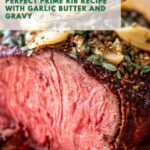
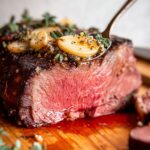
Experience the ultimate indulgence with this expertly crafted Prime Rib recipe, perfect for special occasions and family gatherings. Featuring a succulent 8-pound prime rib roast seasoned with kosher salt and seared to perfection before slow roasting at low temperature, this recipe ensures an evenly cooked, juicy, and tender prime rib. Accompanied by a rich homemade gravy and a flavorful garlic butter sauce infused with fresh herbs, this dish is designed to delight your taste buds with deep, savory flavors and a crispy, golden crust.
Ingredients
Scale
Prime Rib Roast
- 1 8-pound prime rib roast (3 ribs)
- 2 and 1/2 tablespoons kosher salt (see note for substitutions)
- 1/4 cup vegetable oil (divided for searing; light olive oil recommended)
Broth and Gravy
- 2 cups water
- 1 tablespoon Better Than Bouillon Beef Base
- 2 cups drippings (from roast)
- 1 and 1/2 cups water
- 1/3 cup flour
- 1/2 teaspoon black pepper
- 2 tablespoons butter (optional)
Garlic Butter Sauce
- 1 cup butter (2 sticks)
- 15 cloves garlic, thinly sliced
- 2 teaspoons granulated garlic
- 3/4 teaspoon kosher salt
- 2 teaspoons fresh black pepper
- 1 and 1/2 tablespoons fresh rosemary, finely chopped
- 1 and 1/2 tablespoons fresh thyme leaves
Instructions
- Gather your tools: Use a reliable probe meat thermometer that stays inserted throughout cooking to ensure perfect results.
- Choose your prime rib: Request prime-grade “first cut” ribs 10, 11, and 12 from your butcher for the best quality.
- Talk to your butcher: Ask the butcher to remove rib bones and tie them back with twine; if not done, you’ll do it yourself.
- Prep your roast: Prepare your roasting pan with a rack or cooling rack over a baking sheet; gather kitchen twine and kosher salt.
- Cut off the bones: If necessary, carefully cut the rib bones off with a sharp serrated knife following the bone’s curve.
- Separate roast and bones: If tied, cut the twine and separate roast; keep track of their orientation for reassembly.
- Score the fat: Using a serrated knife, score the fat cap in a crosshatch pattern without cutting into the meat to help salt penetration.
- Salt the roast: Thoroughly rub 2 and 1/2 tablespoons kosher salt all over the roast including into the crosshatch slits and on the exposed bone side.
- Place the roast on a rack: Arrange the bones first, then the roast on top to avoid juices pooling. No need to tie now.
- Refrigerate: Chill the salted roast uncovered for 24 to 48 hours to dry brine and enhance flavor and tenderness.
- Bring to room temperature: On cooking day, leave the roast out for 2 hours to ensure even cooking.
- Preheat oven: Set your oven to 200°F for slow roasting.
- Sear the roast: Heat a 12-inch stainless steel pan over medium-high heat, add 1/4 cup oil, and sear the roast on all sides until crispy and browned, about 2-3 minutes per side and edges.
- Sear the bones (optional): Sear the bones in the same pan for additional flavor.
- Make a broth: Add 2 cups water and 1 tablespoon beef bouillon to the pan, bring to a boil scraping browned bits, and pour broth into the roasting pan.
- Reassemble and tie the roast: Place bones on the rack, set seared roast on top in original orientation, and securely tie with kitchen twine.
- Insert probe thermometer: Insert into the thickest part of the meat and set alarm for 110°F.
- Cook roast: Place roast on the lower oven rack at 200°F and roast until thermometer reaches 115°F.
- Turn off oven: Crack open oven door and leave roast inside to continue cooking slowly from residual heat.
- Check temperatures: Remove roast when internal temperature reaches 125°F for rare, or 130°F for medium-rare.
- Rest the roast: Transfer roast to a carving board, tent loosely with foil, and let rest for 30 to 60 minutes to redistribute juices.
- Make the gravy: If necessary, separate fat from drippings, return broth to the pan, bring to boil, then whisk in flour slurry (1/3 cup flour mixed with 1 1/2 cups water) slowly; simmer 5 minutes, add butter and black pepper, adjust salt and bouillon to taste.
- Make garlic butter sauce: Melt 1 cup butter over medium heat, add garlic slices, granulated garlic, salt, and black pepper; cook 2-5 minutes until fragrant and lightly golden, remove from heat, stir in rosemary and thyme, then set aside.
- Broil the prime rib: Place rested roast back on rack in roasting pan (no gravy), position with foil underneath to level; broil on high for 2-5 minutes until top is browned and crispy.
- Remove twine and carve: Cut kitchen twine, separate roast from bones, transfer to carving board, drizzle with garlic butter sauce.
- Serve: Slice the prime rib against the grain in 1/2-inch slices and serve with garlic butter sauce, gravy, and mashed potatoes.
- Store: Cool leftover prime rib to room temperature then place in airtight container; keeps for 5-7 days refrigerated.
- Reheat: Reheat gently in a 200-225°F oven covered with foil and some liquid for 60-90 minutes; microwave reheating not recommended to preserve texture and moisture.
Notes
- Using a probe meat thermometer is essential to avoid over or undercooking.
- If kosher salt is not available, use sea salt but adjust quantity accordingly.
- Removing bones and tying them back in enhances flavor and insulates the roast.
- Scoring the fat allows better penetration of seasoning and improves tenderness.
- Low and slow roasting at 200°F ensures even cooking and a juicy interior.
- Resting the meat before carving allows juices to redistribute for optimal taste.
- Broiling at the end creates a desirable crispy crust.
- Make sure to bring the roast to room temperature before cooking to ensure even doneness.
- Microwaving leftovers is discouraged as it dries out the meat; slow oven reheating is preferred.